
Glass vial rubber stopper
It is important to select an adequate primary packaging, including glass vial rubber stopper and cone caps for parenteral products, in order to assure product stability, microbiological quality during storage, and patient safety. Its flexibility, chemical resistance and impermeability are the most important properties that make glass vial rubber stopper appropriate to be used as laboratory stoppers. Its flexibility enables medical rubber stoppers for glass vials provide a leak-proof sealing against the interior of the glassware. Its chemical resistance on the other hand will make it reliable and safe for usage in the presence of many corrosive as well as all other reactive compounds. Its impermeability plays a major role in ensuring that liquids and gases do not leave the container. Glass vial rubber stopper in particular, are the most widespread type of container configuration, however there are many shapes of stoppers you can choose from depending on your needs for your final pharmaceutical formulation laboratory supplies, bottles, kettle tubes, flasks, jars, test tubes or similar containers. Is it possible that these glass vial rubber stopper could be used for something different from glass vials? Well, no, actually they are designed to be used specifically for sealing the glass vial, which have to be properly stored when they are not in use. However, glass vial rubber stopper do come in a variety of shapes and sizes, and they are commonly used in a wide range of industries. Nevertheless, when choosing a stopper for the application, pharmaceutical manufacturers should consider the design and equipment options as well as they need to take into account the rubber formulation and its processing to provide the most efficient storage and moisture protection for the drug product. Moreover, rubber stoppers provide an easy access to drugs, which are contained in glass vials, because they can be easily penetrated with a needle or a cannula. This type of usage is very common in hospitals in general, as well as in intensive care units in particular, owing to the wide use of injectable drugs packaged in glass vial rubber stopper.
Bottle Stopper Size Catalog
Compare the listed butyl stopper dimensions against the bottle opening and seating arrangement. Confirm the selected profile using the part drawing.
Custom colors are available to your Pantone color code. Include the code in your inquiry.
Butyl Rubber Stopper(Anaerobic bottle stopper)
Compare A, B, C, D and E in mm against the selected stopper drawing. The illustration shows a related profile; confirm the precise underside and fit before specifying the part.

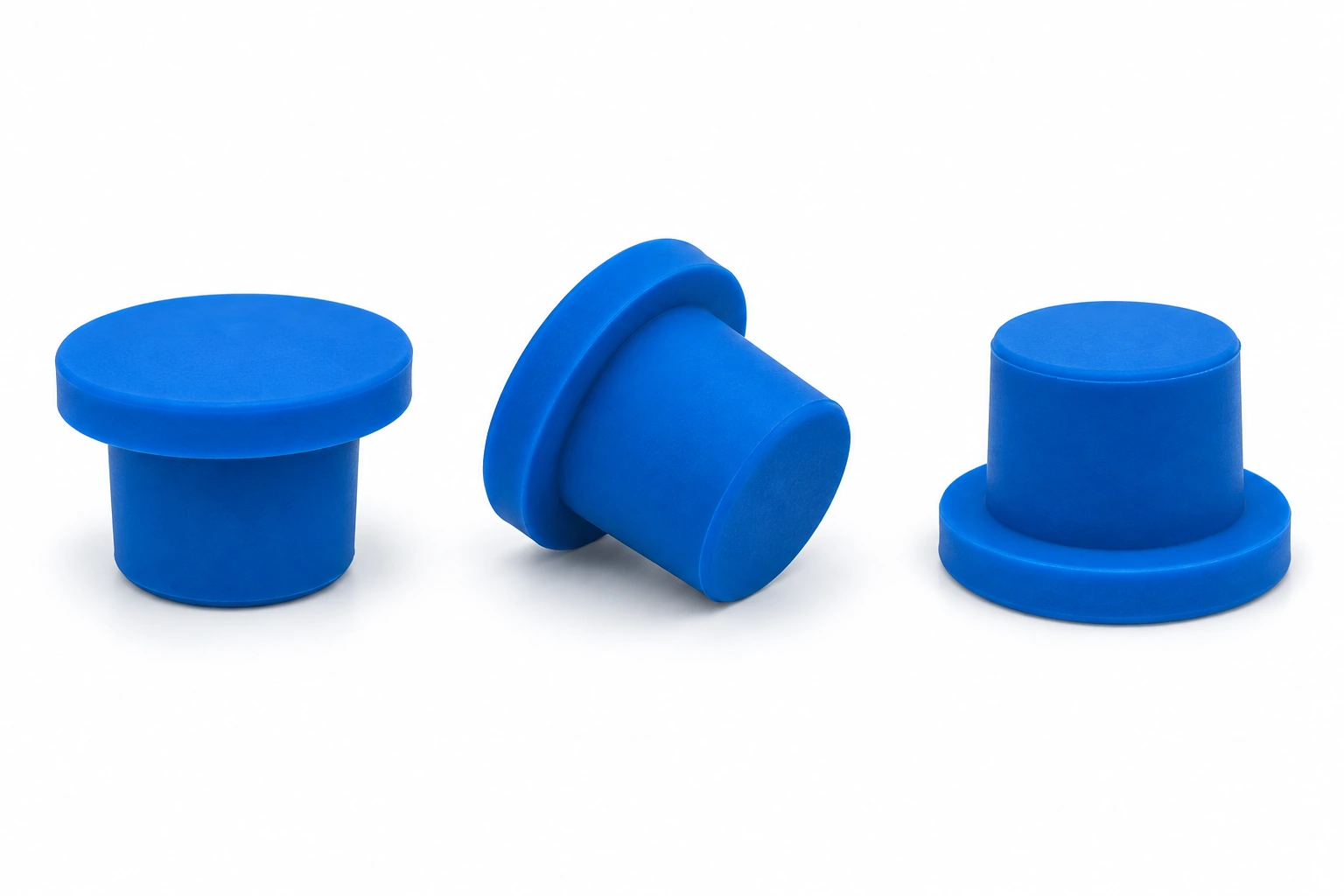
Need a different size? Share your drawing, mating dimensions and intended use to discuss a suitable part.
Discuss Your RequirementsProduct specifications
- Product form
- Vial or bottle closure matched to its neck finish
- Application focus
- Vials, laboratory vessels, bottle necks, laboratory flasks and test tubes. Size the part against the selected assembly.
- Dimensions to confirm
- Vial neck bore, sealing flange, plug depth and any crimp-cap interface. Match these to vials and laboratory vessels.
- Contact conditions
- Other gases and medicinal contents: define concentration, temperature and contact time, then check compatibility with the chosen compound.
- Exposure to evaluate
- Moisture. Validate the selected material under the combined conditions.
- Puncture service
- Where needle access is required, define needle geometry, puncture count and resealing and particle tests for the closure.
- Seating check
- Check the sealing contact around the opening and the force needed for insertion and removal.
Need a quote or a custom part?
Send your requirements, drawings or samples to discuss standard and custom silicone rubber parts.
Email us[email protected]