Contact media
List fluids, gases, cleaners and concentrations. Request compatibility review for the exact compound at the operating temperature.

ETOL is an O rings manufacturer supplying rubber and silicone seals. With over 20 years of experience, our wider range includes more than 18,000 types of rubber products. Send your dimensions and application for custom O-rings. Samples may be available in as little as 48 hours, depending on the design; contact us to confirm timing.
Need a custom color? Include your Pantone color code when requesting a quote.
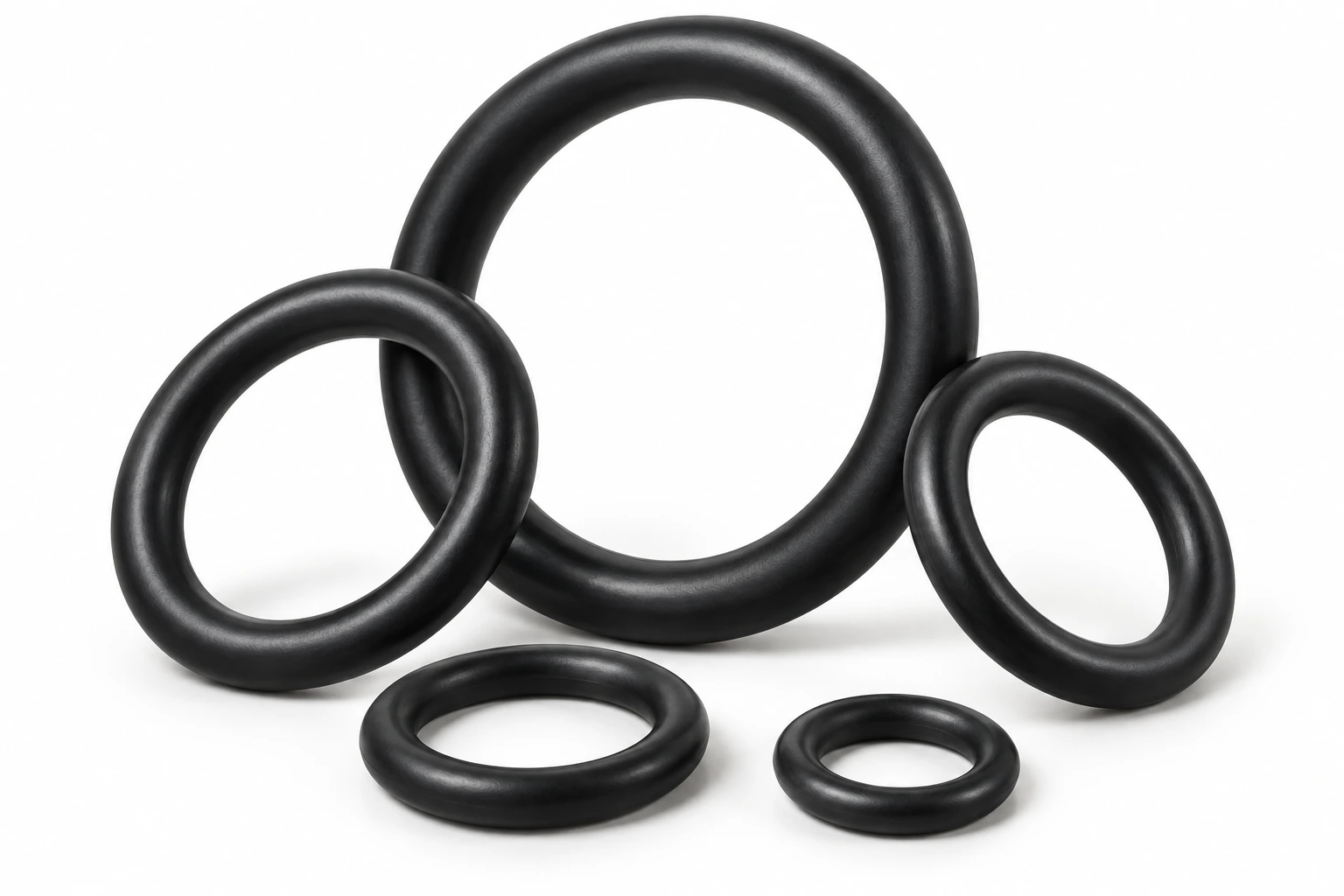
DIMENSIONS · PROFILE · APPLICATION
A practical o-ring brief, from first measurements to sample approval.
Use these reference shapes to describe your requirement. Availability, tooling and dimensions are confirmed after drawing review.
Show whether the seal acts on a face, bore or shaft. Include groove width and depth, mating diameters, clearances and pressure direction. Identify static, reciprocating or rotary service.
Send an assembly section alongside the part drawing. Confirm free size, installed size and tolerances separately. Agree on compression and fit for the selected compound and geometry before approving a sample.
Already specified a compound? Share its grade and datasheet. Otherwise, use this checklist to discuss silicone, EPDM, NBR, CR, FKM or another candidate with our team.
List fluids, gases, cleaners and concentrations. Request compatibility review for the exact compound at the operating temperature.
Separate continuous service from short peaks. Include outdoor exposure, immersion time and cleaning cycles.
State the hardness value and scale if known. For sponge or hollow profiles, include compression-force and recovery requirements.
Identify any contact requirements, test methods or traceability needs for the application. Specify color with a Pantone code.
A polymer name alone does not confirm temperature limits, chemical compatibility or compliance. Final selection depends on the compound, assembly and agreed validation conditions.
Include the following with your drawing. Mark unknown items for review rather than guessing.
Before production: agree on the drawing and compound, check sample dimensions and assembly fit, then evaluate sealing under the agreed conditions.
Discuss Your Seal RequirementsEvery application has its own requirements. From choosing a standard size to developing a custom part, our team can help you explore suitable dimensions, materials and mounting options.
Discuss Your ApplicationAn O ring is a compact sealing ring with a circular cross-section. Also known as packing or a toric joint, it sits in a groove between mating surfaces to help contain liquids or gases.
O rings are used in both static and dynamic systems. In a static joint, the sealing surfaces remain still; in a dynamic system, the seal must also accommodate relative movement.
An O ring oil seal works with an O ring groove that supports and locates the ring. Groove dimensions, compression, material and operating conditions all affect the seal.
Common reasons to choose O-rings include:
O rings are used for high-temperature sealing, vacuum sealing and high-pressure sealing when the material and joint are designed for those conditions. Common applications include:
Oil, gas and manufacturing: Seals in pumps, valves, dispensers and storage equipment need to match the fluid, temperature and pressure. Transportation: Automotive, aerospace and aircraft assemblies require seals suited to vibration and the service environment. Electronics: O rings can help keep dust and moisture out of a properly designed enclosure. Food and beverages: Food-processing equipment, water filtration and beverage dispensers need materials documented for the intended contact. Medical: Syringes, pumps, filtration equipment and connectors require materials qualified for their specific use.
Before replacing an O ring, check the equipment specification, operating pressure, temperature and fluid. Pressure capability depends on the complete sealing design, not just the ring.
Specify the inside diameter and cross-section, using the original drawing or a correctly measured reference where possible. A worn ring may have changed shape. Do not select a smaller size simply because the material can stretch; confirm the fit and compression in the groove.
Follow the equipment's replacement procedure, inspect the groove and fit the new ring without twisting or damaging it.
O rings are available in metric and inch sizes. SAE AS568 is a commonly used reference for inch-size O-rings, covering dimensions, tolerances and size identification. Include the required standard and size designation in your inquiry.
Material selection depends on the application. Options to review include:
With over 20 years in the rubber and silicone industry, we manufacture parts for 30,000+ customers in over 60 countries. Share your application challenges so we can help you define the right part.
Tell us which FDA or RoHS requirements apply to your product. We will review the selected material and part against your application requirements before you order.
Delivery may be available in as little as 3 days, depending on stock and destination. Share your required arrival date so we can confirm the options.
Browse more than 18,000 product types. An existing standard part may meet your requirements without the cost of a new mold.
Want to check the fit and quality first? Free samples may be available for eligible requests. Contact our team to confirm eligibility, availability and shipping costs.
Work with one team from design and prototyping through mold making, mass production and delivery.
Send your requirements or drawing to discuss the right part for your application.